Station groups and multiproduct, multi station loading/unloading

This topic is closed (tagged ).
10 days ago

Good day Captains,

With the most recent update which disables a storage from being connected to multiple train stations, I have several planned projects which I have completely put on pause pending my train network setup, and I was wondering if anyone could give me a pointer to the right direction.

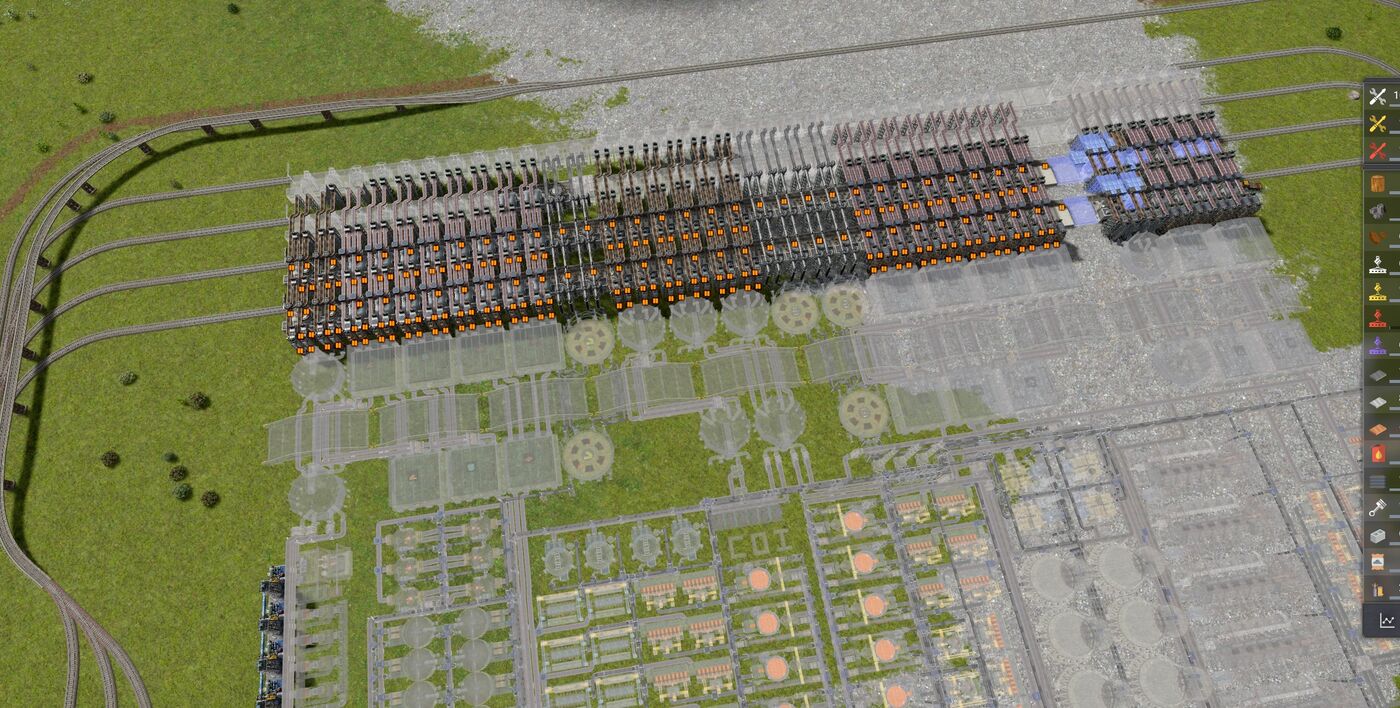
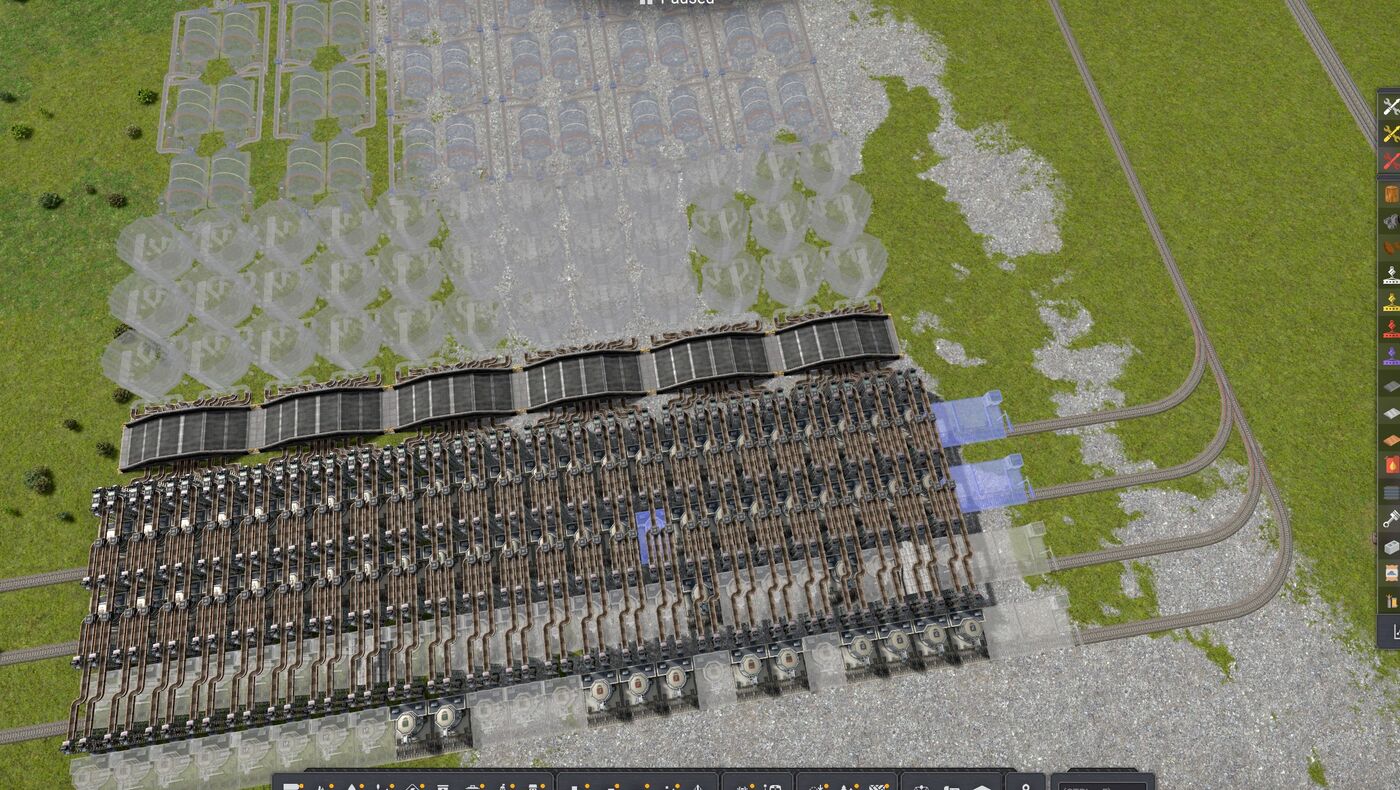
Is there a way to link each station group with a set of storages? Station groups that work in a network? Currently, if I add all the stations to the group, only one of them has the linked storage. I prefer it to behave like a proper group, where the stations act as a destination group, with trains picking the most convenient station. Screenshot_2.jpg
Screenshot_3.jpg

Screenshot_4.jpg

Screenshot_6.jpg

Screenshot_7.jpg

Edited 10 days ago
9 days ago

Unfortunately, "most convenient station" only happens with Train Lines. Train Networks, which those look like Network stations, have a predetermined, immutable destination station from the moment the train is dispatched towards the pickup. Your best bet is probably to build as many layers of output storages as you have stations, then assign each layer to a distinct station, like so:

image.png

While that won't result in a "most convenient" selection, if you rotate the storage assignments on a per-product basis, you can distribute traffic between the stations during periods of low demand rather than overwhelming just one of them.

Note that heavily multiproduct stations like this have an absolute priority in keeping trains moving- you'll want to size the stations/trains to load or unload at least half of a train of each product at once, if not the whole thing- which does, admittedly, tend to defeat the value of having a group of 5 identical stations fed by a single-track input line, since station group throughput will then tend to (significantly) exceed track throughput. Longer trains make for higher track throughput, and on my latest world, I'm planning to use a 4-rail or maybe even 6-rail network with the explicit purpose of enhancing overall throughput.

Edited 9 days ago
6 days ago

Thank you for your detailed response. I'll try something along those lines. And an interesting point about track throughput - I haven't yet run into this bottleneck. You may be much more advanced in the game than I am - I am still running an extremely simplistic train system - One food train line running loops to the city with 2 trains. Supplies my entire population food and medical. Then 3 networks - Loose, Fluid, Flat. I just add more trains to each network as I stop seeing them in waiting bays. I should always have a few trains waiting around for the next call. Waiting bays are located right at loading areas with limited spots available strategically around the map. It does mean that a single loose network train might be on one island picking up coal, then end up at the sulfur pick up, then end up at a limestone mine grabbing the rocks. It sounds chaotic, but it really just works for me. Track throughput doesn't seem to affect me much, even with some unoptimized areas of my main line. Thats going to be fixed sooner rather than later with a big redesign coming to my existing mess. I'm not sure whats going to happen when I triple or quadruple the number of trains running.

5 days ago

AsurfAholic wrote:

Thank you for your detailed response. I'll try something along those lines. And an interesting point about track throughput - I haven't yet run into this bottleneck. You may be much more advanced in the game than I am - I am still running an extremely simplistic train system - One food train line running loops to the city with 2 trains. Supplies my entire population food and medical. Then 3 networks - Loose, Fluid, Flat. I just add more trains to each network as I stop seeing them in waiting bays. I should always have a few trains waiting around for the next call. Waiting bays are located right at loading areas with limited spots available strategically around the map. It does mean that a single loose network train might be on one island picking up coal, then end up at the sulfur pick up, then end up at a limestone mine grabbing the rocks. It sounds chaotic, but it really just works for me. Track throughput doesn't seem to affect me much, even with some unoptimized areas of my main line. Thats going to be fixed sooner rather than later with a big redesign coming to my existing mess. I'm not sure whats going to happen when I triple or quadruple the number of trains running.

Yeah, single-track throughput is pretty high. It's dictated by train reservation time- how long it keeps any given track segment reserved- and tends to be, in my experience, around 10 trains per month. I had 50 or so 8-car, T2 steam trains running around a fairly compact, single-track-each-way network (set up the same way you just described, actually), and I actually had to optimize the mainline connections for the shed (which doubled as refueling point) because that particular point of the network was at something like 90% track utilization, causing short backups to be frequent and long backups to quickly involve every train on the network.

Longer trains will have lower track throughput by train count, but higher by product volume; faster trains will tend to actually have lower track throughput thanks to the exponential increase in follow distance; and so on. With the short trains that stations like these are optimized for, you'll have much lower product throughput when your network starts choking on trains, and you'll get better results with multiple parallel mainlines- possibly even 3- or 4-track each way, if all your stations are all built to have the kind of throughput of the ones in your images.

Edited 5 days ago
104 Showing 14 of 4
Log in to reply.