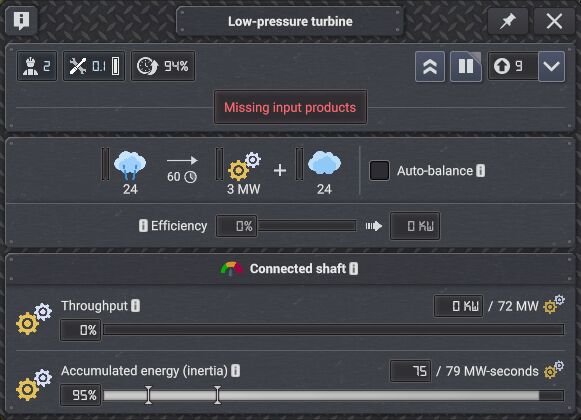
All inputs to the shaft have been disabled. There are generators on the output, but no demand for them to do anything.
Thus: Zero input, zero load. Zero throughput.
While I can't seem to find any tooltips that specify what happens in this situation, what normally happens- and will happen when the shutdown is caused by Auto-Balance- is that friction takes over, and the accumulated energy bleeds away.
What is happening in this case... well, friction (or maybe turbine backpressure) reduced it to 95% inertia, but then it stopped going down. It sat for a couple of months and, as I am writing this, power demand finally grew high enough- briefly- for the generators to kick it down a few MW-seconds. They promptly turned off again, so friction took over and the inertia quickly drained to nothing.
It is weird for the shaft to have this singular speed at which it is completely frictionless- even if friction only exists under the zero-throughput condition, undoubtedly to keep flywheels from slowly spinning forever. It would be nice to have friction losses be reduced at high inertia levels, so I don't have to bolt a wasting generator to every shaft in order to reduce standby losses in thermal storage plants, but this... Not this way.
Update 4.2 | v0.8.6c (b612)
Reproduction:
- Build a shaft with power input (mine was a coal power plant).
- Disable any power output (mine was by satisfying the low energy need with solar)
- Disable any Auto-Balance settings
- Let it sit until the inertia equalizes with the total waste of the input steam energy
- Turn off the steam input
- Watch the inertia stop going down!
Potentially Important: My power plant was a "baseload" plant; with no auto-balance, there was no need for flywheels, so there weren't any. Have not tested with them.